I. What Is Delimitation, and Why Should You Care?
Let us begin with something that should require no debate whatsoever – a constitutional mandate. Article 81 of the Constitution of India is unambiguous: the allocation of Lok Sabha seats to states shall be on the basis of their population, as determined by the last census. Furthermore, Article 82 mandates that after every census, a Delimitation Commission – a quasi-judicial, independent body whose orders have the force of law – shall redraw constituency boundaries and re-allocate seats in proportion to the updated population data. This is not a political preference. This is not a partisan agenda. This is the law of the land, written in black and white by the framers of the Constitution, who were wise enough to understand that a democracy without proportional representation is not a democracy at all – it is a dressed-up oligarchy.
Constitutionally, the purpose of delimitation is elegant in its simplicity: every Indian citizen’s vote must carry the same weight, regardless of which state, district, or town they were born in. The moment one Member of Parliament represents five lakh people and another represents thirty lakh people, you have created two classes of Indians. The citizen represented by the under-stretched MP gets a better shot at governance, more responsive representation, and a higher statistical chance of their problems being heard and addressed. The citizen represented by the overburdened MP – responsible for a constituency so dense and sprawling that effective governance becomes a logistical impossibility – is functionally a second-class voter. This is not a south-versus-north problem. This is an Indians-versus-bad-policy problem.
Politically, the argument is just as airtight. An MP’s capacity to govern is finite. His time, his staff, his budget, his physical presence – all of it is constrained. When you ask one MP to serve the needs of 2.7 million people instead of one million, you are not just reducing efficiency; you are guaranteeing failure. You are creating the structural conditions for appeasement politics, where an MP does not solve the problems people are actually suffering from, but rather the problems that are loudest on campaign trails. Delimitation is therefore not merely an administrative exercise – it is a democratic correction, a recalibration of the country’s governance infrastructure. Refusing to do it is like refusing to service an engine because you’re afraid of what the mechanic might find.
II. The Status Quo: A Half-Century of Frozen Injustice
1971 and the Photograph That Never Changed
The 1971 census counted India’s population at approximately 548 million people. At the time, the Lok Sabha had 543 seats – roughly one Member of Parliament per million citizens. The distribution broadly followed regional population shares: the more populous Hindi heartland (Uttar Pradesh, Bihar, Madhya Pradesh, Rajasthan, and their neighbours) held a larger share of seats, while the comparatively less populous southern states (Tamil Nadu, Kerala, Karnataka, Andhra Pradesh) held a proportionally smaller share. This was fair. This was constitutional. This was democracy functioning as designed.
Then came Indira Gandhi.
The 1976 Freeze: Political Cowardice Dressed as Social Policy
In 1976, during the Emergency, the 42nd Amendment to the Constitution froze the number of Lok Sabha seats allocated to each state until the census of 2001. The stated rationale was to avoid “penalising” states that had made progress in population control. On the surface, this may seem compassionate. Look just one layer deeper, and it is nothing short of a constitutional outrage.
The argument essentially went: since some states have controlled their populations better, and since seat allocation is proportional to population, those states should not lose seats just because they were responsible. On pure emotional instinct, one might even nod along. But here is where logic enters the room and sentiment must sit down quietly.
The constitution does not operate on sentiment. It operates on principle. And the principle – inviolable, foundational – is one person, one vote, one value. The moment you freeze seat distribution to protect some states from the consequences of responsible governance, you simultaneously deprive other states of their constitutionally guaranteed representation. You are not being kind to the south; you are being unjust to the north. And the fact that north Indian politicians failed their own people in terms of education, healthcare, and population control is a separate accountability problem – it does not strip a north Indian farmer’s child of their constitutional right to be equally represented in Parliament.
Then, in 2001, came Atal Bihari Vajpayee. Having just concluded a census and lacking the numbers in Parliament to undertake a constitutionally due delimitation, his government passed the 84th Amendment, extending the freeze for another 25 years – until 2026, or effectively until after the next census. The reasoning was similar: give states more time, avoid political controversy. The consequence was the same: another generation of Indians disenfranchised by arithmetic.
So here we are in 2024, with the freeze effectively lifted. And the numbers tell a story that should embarrass everyone who let this drag on for fifty years.
The Mathematics of Neglect
India in 2024 has a population of approximately 1.44 billion – nearly three times what it was in 1971. The Lok Sabha still has 543 seats. Do the arithmetic: in 1971, one MP represented roughly one million Indians. Today, one MP represents roughly 2.7 million Indians. The “democratic” Parliament of India represents its citizens at less than 40% of the efficiency at which it did when the current seat distribution was last legitimately set.
Now consider a specific comparison that crystallises the absurdity: Delhi and Kerala. Delhi and Kerala have broadly comparable populations, yet Delhi sends 7 Members to the Lok Sabha while Kerala sends 20. That is not proportional representation. That is a relic – a fossilised artifact of 1971 demographic realities being forcibly applied to a country that has changed beyond recognition. And here is the savage irony that deserves to be said plainly: the narrative that the south is being “punished” for good governance is, in the current status quo, actually backwards. It is the north that is being punished. It is the north Indian states – overburdened, underrepresented, structurally disadvantaged by a frozen Parliament – that have been denied their constitutional due for half a century. The “over-representation” that southern states currently enjoy in Parliament is not a reward for good governance; it is an unconstitutional anomaly that happens to benefit them. We will revisit this more fairly shortly – but let’s be honest about who the actual victims of the freeze are before we continue.
If delimitation were conducted today on the basis of the 2011 census – the most recent completed census – the results would be striking. States like Uttar Pradesh would see their seat count rise from 80 towards nearly 100. States like Kerala would see theirs fall from 20 to potentially as few as 9. This is not cruelty. This is arithmetic. It is the Constitution doing what it was designed to do – ensuring that every Indian’s vote matters equally. The fact that this feels uncomfortable to some people is a measure of how badly we have drifted from the constitutional ideal, not a measure of how unfair the correction would be.
III. Population Control: The South’s Genuine Achievement and the Democratic Paradox
Giving Credit Where It Is Due
Let us be absolutely clear about something: the southern states of India – Tamil Nadu, Kerala, Karnataka, Andhra Pradesh, Telangana – have done what northern states have largely failed to do. Through decades of investment in female education, healthcare infrastructure, economic diversification, and genuine population control policies, they reduced their fertility rates to near-replacement levels. This is not a small achievement. It is remarkable, praiseworthy, and deserving of recognition. The intellectual, economic, and social capital accumulated in southern India is extraordinary, and any honest Indian must acknowledge it.
But acknowledging achievement is not the same as rewriting the rules of democracy in its favour. And this is the crux of the paradox.
The Historical Root Nobody Wants to Acknowledge
Now, before the familiar narrative takes hold – that north Indian states simply had incompetent politicians and irresponsible citizens – let us inject some historical honesty into this conversation, because the population differential between northern and southern India is not primarily a story of governance failure. It is, in very large and underappreciated part, a story of Partition, colonialism, and the human geography of displacement.
When India was divided in 1947, the south was largely insulated from the catastrophe. Most of southern India was either majority Hindu or administered by princely rulers who, by and large, acceded to India under the Mountbatten Plan without the violent demographic upheaval that tore the north apart. The north was an entirely different theatre. Undivided northern India – particularly what is now Punjab, Sindh, western UP, and the North-West Frontier – was a patchwork of British Indian territories, pro-Pakistan nawabs, and Muslim-majority districts. When Partition cleaved the subcontinent, millions of people were uprooted overnight.
Here is the part that rarely enters this conversation: the refugees who flooded into the newly formed Indian republic did not disperse evenly across the country. They settled, overwhelmingly, in northern India – in the United Provinces (later Uttar Pradesh), in Rajputana, in the Punjab remnant, and in Bombay Province – because these were geographically closest to their ancestral lands, culturally and linguistically familiar, and because most of these refugees had neither the resources nor the luxury of choosing otherwise. These were not wealthy, educated families with the means to travel south, retrain, and rebuild. These were, in enormous numbers, poor and illiterate people – the very consequence of British colonial policy in the territories it controlled, where keeping the population uneducated was a deliberate instrument of imperial control. An illiterate population cannot articulate the logic of independence. It cannot organise politically. It cannot resist. This was colonial strategy, not accident.
And so what happened when you concentrated a massive influx of poor, displaced, largely illiterate people into an already strained region – people traumatised by violence, stripped of property, uprooted from everything familiar – is precisely what economic and demographic history tells you will happen: rapid, compounding population growth. This is not a moral failing of north Indians. This is the predictable human response to poverty, illiteracy, displacement, and the absence of the very social infrastructure – education, healthcare, women’s empowerment – that the south had the comparative peace and continuity to develop.
So when South Indian politicians or commentators frame northern population growth as a consequence of north Indian political incompetence or cultural irresponsibility, they are being, at best, historically illiterate, and at worst, deliberately dishonest. The population pressure of northern India is, in no small measure, yet another cascading consequence of the Two-Nation Theory and the catastrophic Partition it produced. The north is already paying the price for a history it did not choose. The south, spared that particular wound, developed in relative demographic peace. To then argue that the north should be further constitutionally penalised – denied proportional representation – on account of a population surge rooted in colonial exploitation and Partition-era displacement is not a position of justice. It is the compounding of one historical injustice with another, dressed up in the language of demographic fairness.
The Structural Democratic Danger
Here is what the status quo – if left uncorrected – actually produces over the long run. Since northern states have larger populations, and since seats in Parliament are eventually going to have to reflect population (the Constitution is unambiguous on this), any party that dominates the north of India will, by pure arithmetic, dominate Parliament indefinitely. If the freeze is maintained and the current distortions are allowed to calcify, you do not prevent this outcome – you delay it while simultaneously making the eventual reckoning more violent and more politically destabilising. Worse, if the freeze is eventually lifted based on, say, the 2031 census, the demographic divergence will be even more extreme and the seat realignment even more dramatic.
Think about what this leads to structurally: a scenario not unlike Pakistan, where the political centre of gravity is so heavily concentrated in one region – Punjab – that winning that region is effectively sufficient to win national power. An India where the Hindi heartland is so politically dominant, not by design but by sheer demographic arithmetic, that southern India becomes a permanent opposition without constitutional recourse. That is the ticking clock that the Delimitation Bill was trying to defuse. And the opposition, in its infinite wisdom, chose to let it keep ticking.
The BJP’s Dilemma – and Its Character
Now let us talk about the Bharatiya Janata Party, which is significantly stronger in northern India than in the south. Let us also talk about what any purely self-interested political party would do in this situation.
If the BJP were a party that thought of itself before the nation – which, to be fair, is the behaviour of most political organisations in most countries – it would do nothing. It would simply allow the constitutionally mandated delimitation process to proceed on the basis of the next census, watch the north’s seat count balloon, and collect its electoral dividends for the next three decades. This is the path of political opportunism, and it would be perfectly legal. The Delimitation Commission is a quasi-judicial body; its process is constitutionally sound; no one can challenge it in court.
But Prime Minister Modi did not take that path. And before the opposition and the Indian liberal commentariat – those permanently outraged, perpetually confused, reliably wrong interpreters of everything this government does – dismiss that statement as partisan cheerleading, let me show you why it is factually accurate.
IV. The Bill: When You Increase the Pie Instead of Fighting Over Slices
The Idea
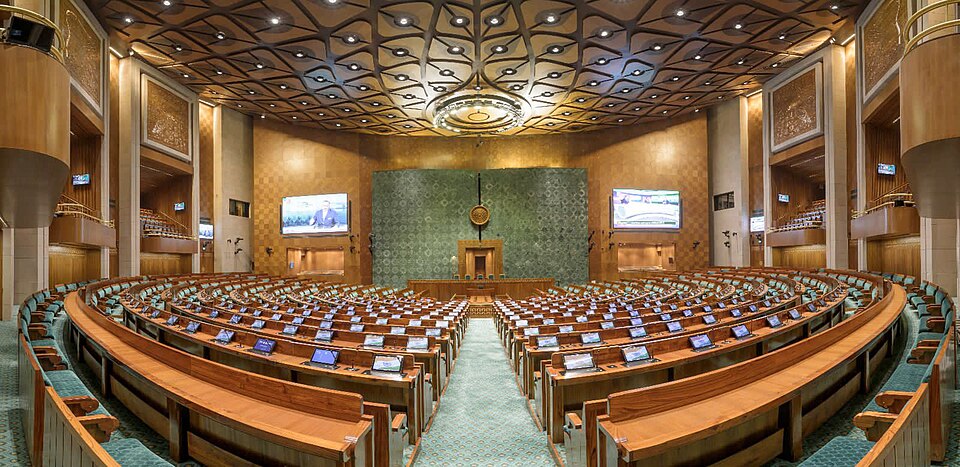
The delimitation bill proposed something simple, elegant, and mathematically fair: instead of reallocating seats based on new population data (which would drastically increase northern seats and reduce southern ones), increase the total number of seats by 50% for every state, while maintaining the proportional distribution of the 1971 census.
Let us do the mathematics carefully, because apparently this is necessary for a significant portion of the political class.
The Mathematics, for Those Who Apparently Need It
Suppose the Parliament has 100 seats. The north holds 60 (60%) and the south holds 40 (40%). This reflects their 1971 demographic shares.
Now, apply a uniform 50% increase to every state’s seats. The north goes from 60 to 90 seats (+30). The south goes from 40 to 60 seats (+20). The new Parliament has 150 seats.
And now, the part where some politicians apparently lost the plot: 90 out of 150 is still 60%. 60 out of 150 is still 40%.The proportional representation of every state is identical to what it was before. No state is punished. No state is rewarded. Every state simply has more MPs than it did yesterday, while its share of the national Parliament remains constant.
Furthermore, the majority required to form a government in a 150-seat Parliament is 76 – exactly 50% of 90, the same 85% of northern seats that would be required in the 100-seat Parliament. The arithmetic of coalition-building, regional dominance, and electoral strategy does not change. The statistical landscape of Indian politics is entirely preserved.What changes – the only thing that changes – is that each Member of Parliament now represents fewer people, which means better governance, more responsive representation, and a fighting chance for the Indian citizen who has been crushed under the weight of a Parliament that has not scaled with its country for fifty years.
And here is the detail that should permanently silence anyone calling this a BJP power grab: the bill proposed maintaining the 1971 census proportions – Indira Gandhi’s proportions. The very Congress government whose Prime Minister froze delimitation in 1976 set the distribution template that the BJP’s delimitation bill would have preserved. The BJP was not rewriting the rules. It was proposing to honour the constitutional framework while scaling the system to serve India’s tripled population.
The Fun Fact the Opposition Didn’t Want to Hear
Here is something even more interesting – something the opposition, the regional satraps, and the army of misinformed commentators completely ignored in their rush to manufacture outrage.
The delimitation bill would, in several ways, actually disadvantage the BJP within its own strongholds. Consider Sultanpur in Uttar Pradesh – a BJP fortress. Under the current system, Sultanpur’s BJP-leaning electorate is concentrated in one constituency, delivering a reliable seat. When UP’s total seats increase from 80 to 120, Sultanpur gets divided into two or three new constituencies. The BJP voters who made Sultanpur a stronghold are now concentrated in perhaps one of those new seats. But the other new constituencies carved from that geography may have majority INC or SP voters – and they now get their own seats. The BJP does not gain an extra seat. The opposition gains seats they would not have had before.
The BJP brought this bill knowing it would produce this effect in its own backyard. Tell me again about how this was a political power grab.
The projected final seat count under the bill was approximately 850 seats, making the majority mark roughly 410 – a number no single party in the current political landscape comes close to guaranteeing itself. The political map of India, as it stands today in terms of which party holds which state, would be entirely preserved. The new census results – and their inevitable impact on seat allocation – would be deferred to the 2034 election cycle, giving every part of India time to adjust and plan.
No state loses a seat. Every state gains seats. Every state’s proportional representation is held constant. Governance improves nationwide. And the opposition burned the bill anyway – with MK Stalin literally setting fire to a document that was going to increase Tamil Nadu’s representation in absolute terms, because he was either too misinformed or too committed to his own political theatre to read what was actually in it.
V. Rebuttals: For the Sincerely Confused and the Wilfully Ignorant
A. “South Indian States Should Be Rewarded, Not Penalised, for Controlling Population Better”
This argument rests on a fundamental misunderstanding of what democracy is. The democratic principle at the foundation of the Indian Constitution – and indeed of every liberal democracy in the world – is one person, one vote, equal in value. Full stop.
You cannot tell me that a Tamil Nadu voter’s vote should count for more than a Uttar Pradesh voter’s vote because Tamil Nadu made better policy choices. The moment you accept that logic, you have opened a door through which any imaginable distortion can walk. If South Indian citizens deserve more representation per capita because they managed their populations better, can I argue that Hindus – who have also demonstrated lower population growth rates compared to some other religious communities – deserve more representation per capita? Can I argue that UP should get two votes per citizen because it has more people? Can I propose that TN citizens get half a vote each because their numbers are smaller? Once you untether representation from the principle of equal citizenship and start attaching it to demographic performance metrics, you no longer have a constitution – you have a reward system, and a constitutionally unpredictable, asymmetrical, politically weaponisable one at that.
Furthermore, Article 15 of the Constitution prohibits discrimination on the basis of place of birth. The north Indian citizen who is currently under-represented – receiving fewer MPs per capita than their southern counterpart – is already facing a constitutional deprivation rooted entirely in where they were born. The argument that this deprivation should continue, or be formalised, because of their state’s historical governance failures, is an argument for punishing the individual citizen for the sins of their politicians. That is not justice. That is precisely the kind of arbitrary discrimination the Constitution was designed to prevent.
B. “The BJP Is Just Increasing Seats in Its Northern Strongholds to Win Elections”
This argument collapses on contact with mathematics. If every state’s seats increase by 50% uniformly, and if the majority threshold increases by exactly the same proportion, then the statistical requirements for winning an election are identicalto what they were before. A party that needed 51% of seats to govern needs 51% of the new, larger Parliament as well. A party that previously could not win without southern support still cannot win without southern support. Nothing in the competitive arithmetic of Indian democracy changes.
Moreover, as explained in the Sultanpur example above, the disaggregation of large constituencies in BJP strongholds into multiple smaller ones is more likely to fracture the BJP’s consolidated advantages than to amplify them. The argument of electoral manipulation does not survive even a cursory analysis.
C. “We Don’t Need Delimitation – South India Is Already Ahead, Let the North Catch Up First”
This is perhaps the most destructive argument of the three, and it needs to be called what it is: a justification for the permanent disenfranchisement of hundreds of millions of Indian citizens.
You cannot deny a north Indian citizen their constitutional right to proportional representation because their state’s politicians were incompetent. You cannot tell a farmer in Bihar or a labourer in UP that they must continue to be represented by an MP stretched across 2.7 million citizens, while a citizen in Kerala enjoys an MP for every 1.65 million, because their state failed to develop quickly enough. That is not a democratic argument. That is an argument for making permanent a structural disadvantage that will compound over time.
And here is the danger that this argument wilfully ignores: if you freeze delimitation and continue to under-represent northern India indefinitely, you are not solving the north-south tension – you are incubating it. You are creating the conditions for a political polarisation so severe that when the demographic correction finally, inevitably comes – because the Constitution will eventually be followed – it will feel like an earthquake rather than a managed recalibration. You are building pressure behind a dam and calling it stability.
An India where northern citizens feel permanently cheated by a constitutional framework that systematically under-counts them is an India walking slowly toward a crisis. The delimitation bill was a pressure valve. The opposition destroyed it and called themselves heroes.
VI. Conclusion: Democracy Deferred Is Democracy Denied
Let us state plainly what happened. A government proposed a bill that increased every state’s representation, maintained every state’s proportional share of Parliament, kept the 1971 census-based distribution intact to protect southern interests, improved the quality of governance by reducing each MP’s constituent load, fulfilled the constitutional requirement of periodic delimitation, and – as a verifiable mathematical fact – actually gave the opposition more seats in BJP strongholds while gaining nothing structurally for the ruling party.
The opposition, led by parties more interested in the political optics of resistance than in the substance of governance, and cheered on by regional politicians whose careers depend on stoking north-south grievance rather than resolving it, killed it. MK Stalin burned a copy of the bill on camera. The Indian National Congress – the party of Ambedkar’s Constitution – voted against a measure designed to bring Parliament closer to constitutional compliance.
Let that sink in.
This is not a north-versus-south story. It never was. This is a story about a country that has allowed its democratic infrastructure to age without maintenance for fifty years, and about the rare political moment – and the rare political will – that attempted to fix it. That moment was squandered, not by accident, but by choice. Not out of principle, but out of petty political calculation dressed up as regional pride.
Every Indian – in Tamil Nadu and Uttar Pradesh, in Kerala and Bihar, in Karnataka and Rajasthan – deserves a Parliament that represents them fairly, governs them effectively, and scales with the country they live in. The Delimitation Bill was that Parliament. It is gone now, at least for this cycle. And the citizens of this country – all of them – are poorer for it.
One hopes that the next time an opportunity arises to do what the Constitution demands, the people entrusted with that responsibility will have the intellectual honesty to read the bill before they burn it.
 Kosmonomy
Leave a comment