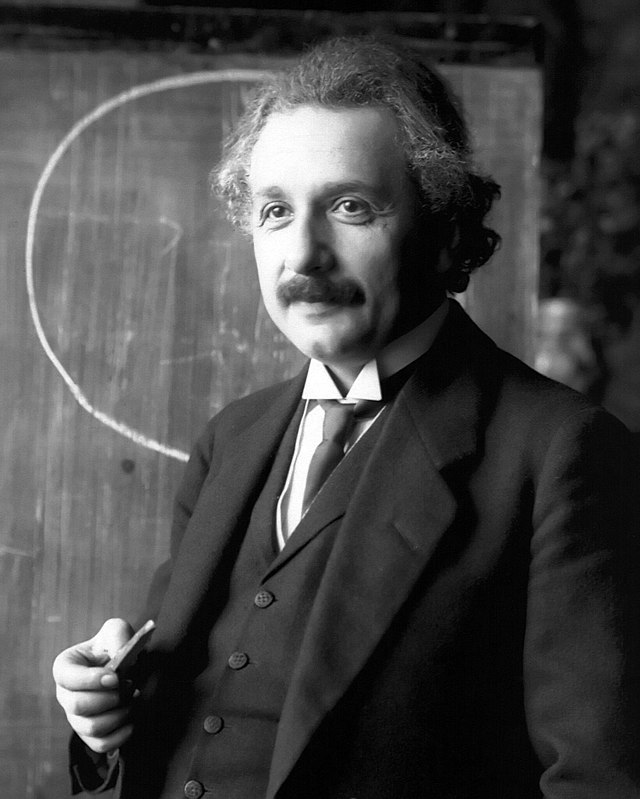
§ the entry of Albert einstein
Before becoming a professor of Physics, Einstein, one of the greatest minds of all time, was a patent clerk. He joined the Swiss Patent Office in 1902, examining the originality, technical merit, and validity of patent applications reaching his desk. It is this job that pulled out his maximum scientific prowess, where he published paper after paper, changing the scientific world.
He was deeply influenced by Planck’s 1900 paper on black body radiations and especially, the idea of quantization. In fact, it affected him so much that he published 4 papers in 1905 alone, all groundbreaking in their own individual sense, possibly being the greatest year of his life.
One of the major reasons was the work ethic of the place. The director of the office directed all employees to approach every new invention and patent application with scepticism, asking what might be wrong with it at every step. This, and the fact that Einstein came across many invention ideas, such as an electromechanical device to synchronize distant clocks, were directly responsible for refining his thinking and helping him produce papers like that on special relativity.
At the ripe age of 26, he published the paper on the photoelectric effect on March 17, 1905. He also later in that year would publish papers on Brownian Motion, Special Relativity, and Mass-Energy equivalence.
His first paper on the photoelectric effect is also what earned him the Nobel Prize in Physics, the particulars of which we will discuss here.
§ the photon hypothesis
Since Einstein’s ideas are built on the backbone of Planck’s hypothesis, it will be extremely useful to go back to the hypothesis, only now with a different lens. Remember, Planck was always a firm believer in the classical theory(so was Einstein, but the latter was much more open and accepting of the ideas leading to the actual concrete quantum theory).
The following discussion is for only electromagnetic waves.
Now, the classical theory of physics predicts that light is continuous. Meaning, it’s water flowing in a pipe. It’s not really a multiple of some constant, but rather a stream. Planck had a different idea.
His idea was that instead of energy literally coming like a stream of water, it came in multiples of a constant, like a bucket of water. Each bucket of water corresponded to one constant – or a packet of energy. He called one packet of energy a quanta and multiple quanta, a quantum.
Another way to imagine this is by taking water in a glass. Instead of energy flowing from glass to glass by pouring it, you would take a spoonful and pour it into the other glass – the place where the energy needs to be transferred. That energy was E = nhf. One spoonful would be hf, two would be 2hf, and so on. The frequency was the frequency of the source that produced the light in the first place(because the paper was about black bodies and the source was an atomic oscillator – the atoms in the walls of the black body), h was a constant, and n was just a natural number indicating the number of spoonfuls of water.
But this is kind of weird because what is stopping you from taking half a spoonful, or two-thirds, or any ratio between no water in the spoon and the spoon being full of water? In that case, n will not be a natural number, and the idea of quantization will break.
This is where Einstein comes in. His idea was that the glass does not have water at all. It has ice cubes. Now, you can’t take half an ice cube or two-thirds or somewhere in between – you have to take a complete ice cube. Well, can’t you break the ice cube in half? Yes, but the task is to pick out whatever is in the glass, or the energy reservoir, not tamper with the form of the energy itself. Plus, the glass and ice cubes are only a representation of the phenomenon, not the phenomenon itself. In any case, you have no option now but to take energy from the glass in multiples of a constant – the ice cube. You can take one ice cube(hf), or two(2hf), or three(3hf), and so on.
Now, once Einstein laid this to be the framework of his theory, he then redefined the photoelectric effect and the nature of light itself.
When we think of the ice cube and glass experiment, what does the individual ice cube actually represent, when all ice cubes represent the total light? It must be a quantum of light if Planck’s theories must hold. Einstein called this quanta, the photon. And since it’s a discrete quantity, it can’t be a continuous entity – it must be the opposite – a particle. The photon is a particle. Light is made of particles!
Now, what happens once we apply this to the photoelectric effect?
When light shines on a piece of metal, these photons(the ice cubes) are absorbed by the electrons. One electron absorbs one photon. It’s not a rule, but the probability of an electron absorbing multiple photons spontaneously is negligible, although possible in controlled testing facilities. The electrons ejected are obviously the electrons on or near the surface, in the valence shell of their respective atoms.
Now, once an electron comes across a photon, it absorbs the photon and gains its energy. This energy, if high enough, can allow the electron to overcome the forces of attraction from its own and other neighbouring nuclei to literally be ripped from the metal and be ejected. The ejected electron is called the photoelectron.
Higher frequency means the individual photons have much higher energy, as their energy is equal to hf. Thus, the electrons absorb much higher-energy photons, and the ejected electrons have, in turn, high energy. Increasing intensity won’t make a difference in the energy of the individual ejected electrons, only in the number of electrons that are ejected in the first place. This is because increasing the intensity just increases the number of photons hitting the metal plate at a given time.
Now, each electron has some bond to its own nucleus(even if small), thus it’s a valence electron and not a free electron. The energy that the photon gives to the electron needs to not only suffice for it to be ejected out with some kinetic energy, but also to leave the metal atom it is attached to in the first place. That energy is called the threshold energy.
Different metals are made of different atoms, each having different energies of attraction on their valence electrons; thus, each metal has a different threshold energy. The energy of the ejected electron is the difference between the energy the light photon provides and the threshold energy to overcome the binding energy of the electron to the nucleus.
Thus –
Energy of the ejected electron = Energy of the supplied photon – Threshold energy
K = E – Φ
E = K + Φ
Thus, the equation for the photoelectric effect is –
E = K + Φ
Here,
E – energy from the photon
K – energy of the ejected electron(can either be eV or 1/2mv2 based on the condition) Φ – threshold energy
But as we know, E is also defined as E = hf. And since this experiment is conducted on electrons, the kinetic energy of the electron can be defined in terms of its charge, e and the voltage needed to stop the electron from ejecting after the light has been shined on the metal, V. Thus, eV = 1/2mv2.
hf = hf’ + eV
(Here, since f is also of the form E = hf, the f’ is defined as the threshold frequency needed for ejection of photoelectrons)
hf – hf’ = eV
h(f – f’) = eV
Hence,
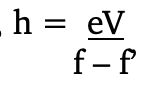
Therefore, Einstein also provided a way to calculate the value of h with ease, a constant which no one knew what it represented or what the exact value of it was before.
Robert Millikan, a famous American Physicist, did not buy into this. He simply refused to believe that calculating the value of such a radical constant was such basic algebra. So, between 1914 and 1916, he conducted experiments on the photoelectric effect.
And to his surprise, the value of h he found not only sufficed for experiments, it also perfectly fit within the theory as well. The value he calculated was h = 6.57 * 10-27 erg-second, within 0.5% of the currently accepted value.
the special theory of relativity
This is possibly among the greatest accomplishments of the human race. This singular theory completely redefined the way we see our world. This theory still boggles the minds of the scientific community because of its contents of this theory. Some still disagree, but are not able to produce concrete evidence to disprove this great theory. The successor to this theory was the general theory of relativity, but that is of little importance to our discussion here, so it will not be mentioned anywhere in this paper.
Einstein published this paper on the special theory of relativity(On The Electrodynamics of Moving Bodies, June 1905) 3 months after his paper on the photoelectric effect(On a Heuristic point of view concerning the Production and Transformation of Light, March 1905). In the same year, this man broke all conventions and declared that light is a particle and then also theorised what you will read ahead(no spoilers). Therefore, ladies and gentlemen, allow me to present to you the special theory of relativity.
We start our discussion with the concept of inertia. Yes, that age-old boring concept Newton theorized, which anyone who has passed their 8th or 9th-grade Physics class knows. The concept literally says that things at rest stay at rest and things in motion stay in motion(unless acted on by some external force). Well, for the time being, consider this concept of inertia as Newtonian relativity, purely for namesake.
We also need to understand the concept of a ‘reference frame’. In the simplest words, it is a system from which one can measure the position or speed of a particle or another system. For example, if you are standing on a train track, that is a reference frame at rest. When the train flies by you, one can measure the speed of the train standing from the station using various instruments, and also the position of the train at some particular point in time once it enters the station. On the converse, if an observer is standing inside the train, for them the train is constant (because the engine causes both the train and the person to move at the same speed, thus the relative speed is zero). Thus, for the observer looking through the train window, the person on the station, the station, and the person are moving at the same speed as the train in the opposite direction. Meaning, for the person inside the train, the whole world is moving in the opposite direction at the same speed. This person can also measure the speed of the person on the station, the station itself(which is the same), and positions. Neither reference frames have any hierarchy over the other, as you can imagine, because for both, they are at rest while the world around them moves.
But common sense, basic intuition, and anyone with a mind capable of rational thought will NOT be convinced. I mean, the entire philosophy of light revolves around prioritising the frame at rest, right? I mean, ANYONE would agree that the train is moving, not the person at the station. But how do you prove it?
Look at this experiment. There is a person in a red coloured convertible car without a lid(probably rich but not relevant) and another guy at the end of the road. Looking at these two pictures, one would conclude that the car moves from left to right towards the guy at the end of the road.
But how do you prove that it’s the car that is moving? This question is important because the person in the car can argue that it is I who is stationary, while the guy and the road move to the left. I mean, think about it – you can literally conclude that imagining the road and the guy move to the left with the car just chilling there, and the road beneath the tyres sliding to the left.
For the rest of our discussion, assume the person in the car is Einstein and the guy at the end of the road is you. Okay, now you use your brain and come up with an idea. You tell Einstein to throw a ball up in the air as he and his car move.
You might expect that the car moves ahead and the ball just goes up, down, and falls on the ground at the same spot it was launched from, while the car is now ahead. Basically, this –
Contrary to most experiments shown on the internet, I beckon you to try this at home (the red coloured convertible is not necessary). When you do, you find out that this is NOT what happens. Actually, it is this that happens –
Yes, this is exactly what happens. You catch the ball back. And the reason is simple. Remember our conversation about inertia? Well, apply it. Even before the ball is shot up, it is on the car moving with the car and Einstein. So, it is in inertia with the car. When we launch it up, we are not giving it any force, rather imparting a constant speed to it(if you actually try it, it will land back on the car, but a bit back because imparting constant speed with a hand is hard). Thus, its inertia of motion with the car does not break, and it continues to move forward alongside its vertical movement. If the trajectory is drawn, you will see it to be a parabolic trajectory, but for Einstein, the ball goes up and then comes back down.
A similar thing happens when you shoot a bullet. If the speed of the bullet is v and the car moves at v, you would think Einstein shooting the bullet from a gun from the car would result in the car moving alongside the bullet. That would again be wrong because the bullet in the chambers of the gun is in inertia with the car moving at speed v. When the gun imparts it another speed v, the bullet moves v ahead of the car, as for Einstein, he is at rest. But for you, the bullet moves at 2v because the bullet has the speed of the car and the bullet.
Now, what does any of this have to do with our original discussion? I mean, you(the reader you, not the experiment you) probably learned all this and then are now reading this paper. But it’s important.
See, now we extend our discussion to waves. What would happen if Einstein, instead of using a gun, used a speaker to produce sound waves, or more generally, produced waves instead of particles like bullets? This is important because light is a wave.
We need to understand something VERY IMPORTANT before we proceed. See, unlike particles, waves don’t actually ‘move’ in the standard sense. They oscillate back and forth from their positions and transfer energy from one point to the other. Sound waves are longitudinal, meaning the particles oscillate in the direction of wave and energy transmission, while light(in general, all electromagnetic(EM) waves) are transverse waves, meaning the particles oscillate perpendicular to the direction of the wave and energy.
If you take a rope and connect one end to a rigid wall and hold the other end, move it constantly up and down, and you will form a transverse wave. But now, if you start moving at the speed at which you are moving your hand up and down towards the wall as you make the wave, you will move with the wave itself. Here is a better way to look at this –
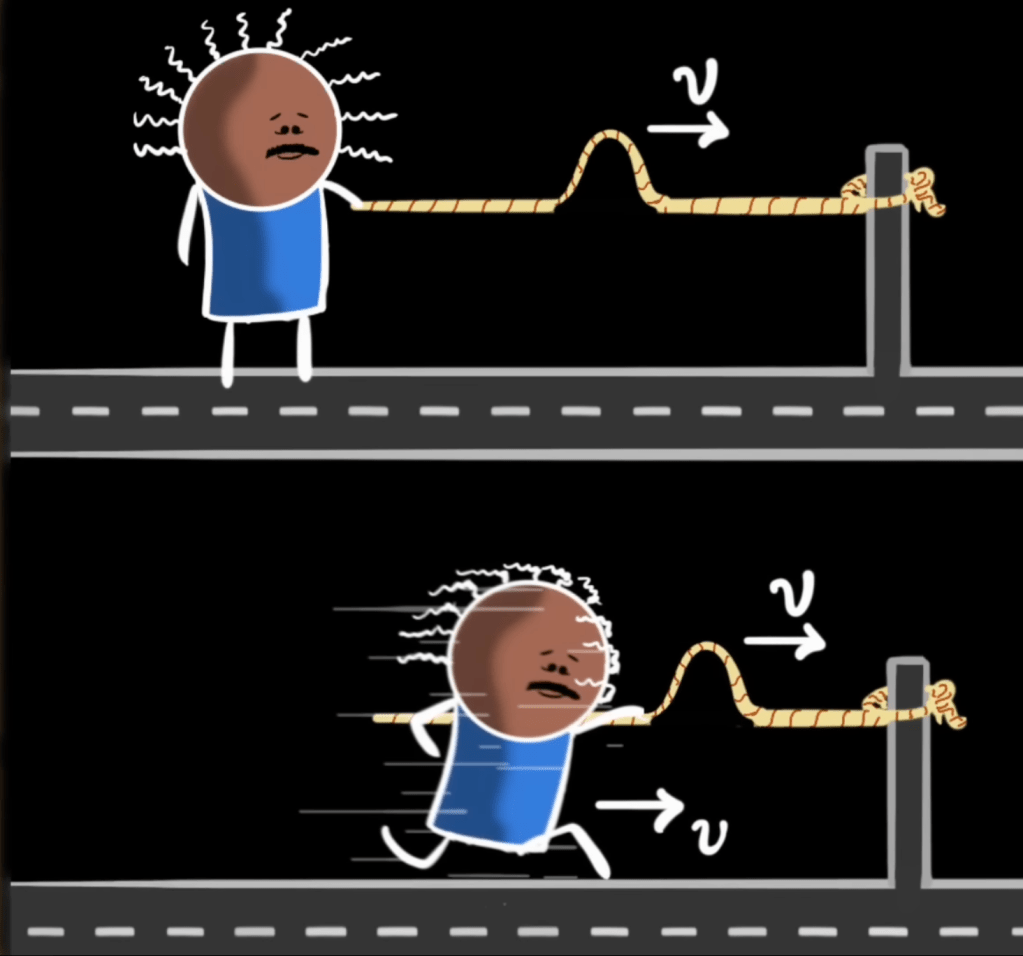
And I think the reason is pretty much clear now because this is not a particle, it’s a wave – you are moving alongside the propagation of energy.
Now let’s get back to the experiment. If Einstein were to produce a sound wave at some speed v and his car were to also move at that speed v, would he move alongside the sound? The answer is….YES. Yes, he will move alongside the sound. This means he will hear the sound as long as he is moving in the direction of the soundwave and at the speed of the soundwave. For Einstein, sound is frozen.
You may start celebrating now(I hear party noises already), because now you have proven Einstein wrong, as now we can argue that he is moving. The idea is that if you(who argues is at rest) produce the sound, it moves ahead and ahead of you because you don’t run along with the sound at the same speed. But for Einstein, it does not move ahead as understood above. And by Einstein’s own initial experiment with the ball and the bullet, it should. Thus, he has to be moving and not be at rest(otherwise his and your results would match). Great job, except you are wrong.
See, the reason is something I want to explain using the ‘Escalator effect’. In this entire experiment, we never talked about the medium. It’s air. It can’t be a void, else sound won’t be produced(it’s a mechanical wave). If you assume its still air, as Einstein’s car moves at the speed of the sound(say u), the air hits Einstein and the car at that speed in the opposite direction(since he is according to him at rest, the world needs to move towards him at the same speed his car moves at for you, in the opposite direction. This includes the medium air). Thus, when the sound is produced at the same speed, the air blocks the sound wave at every instant from going forward mechanically, making the sound’s relative speed with respect to the car and the person zero, but not with respect to you, because the car is still moving. It’s similar to how, when an escalator goes up and you try to go down on it at the speed of the ascent of the escalator, you don’t actually go anywhere, even though you are moving. Thus the name.
One may argue why the car does not stop because of the air? See, the difference between the car and the sound is that the latter is a wave. Waves, by definition, do not have inertia because no particles move; rather, energy gets transferred through disturbances in a medium. Thus, the car doesn’t stop because, as the definition of inertia says, inertia can only be broken through an external force(opposing air is not a force at constant speed), but the sound stops because it doesn’t have inertia.
What’s the conclusion? Each experiment we tried(and any other you may think of) cannot determine which is at rest and which is in motion. Each of our experiments tried to prove that the car moves, but counter logic proved that the observer and the ground move. The idea is thatmechanical waves and particles cannot detect motion.
But what if we use electromagnetic waves, or light? These waves do not require a medium to propagate, so irrespective of whether there is a wind or there isn’t(vacuum), the speed of the wave Einstein produces from his car remains the same. Now, if Einstein moves at the speed of light in his car as he shines the light, he will move alongside the light with zero relative speed between the two. And there is no way to explain why Einstein won’t be moving. From this and ONLY this, we can prove that definitively, Einstein is the one who is moving.
But now comes another question. What is the speed of light? Okay, well, the value can be calculated from the simple formula we derive from Maxwell’s equations from electromagnetic waves, which defines the speed of light c as –
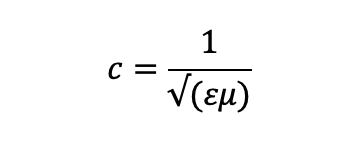
Where ϵ and μ are two physical constants(one for the electrical component of the EM wave, the latter for the magnetic component). This defines the speed of light to be precisely –
c = 299,792,458 m/s
It is exactly this value; there are no decimals.
But here is the thing. All of our discussion is from a time around the 1900s. This was a very different time, where the people of the world had a fundamentally different view and understanding of our world, especially for the scientific community.
During this time, a lot of physicists thought that the speed of light is affected by some medium, even if it doesn’t need one to propagate. They thought there was this thing called the aether, an invisible medium that flowed only in one direction and could affect the speed of light. The logic was that if light ran perpendicular to its direction, its speed wouldn’t change and be c. If it were in the direction, it would be c + the speed of ether, else c – the speed of ether if in the opposite direction.
To test this, the very famous Michelson-Morley experiment was conducted. This experiment was conducted in 1887 by Albert A. Michelson and Edward W. Morley at Case Western Reserve University in the United States.
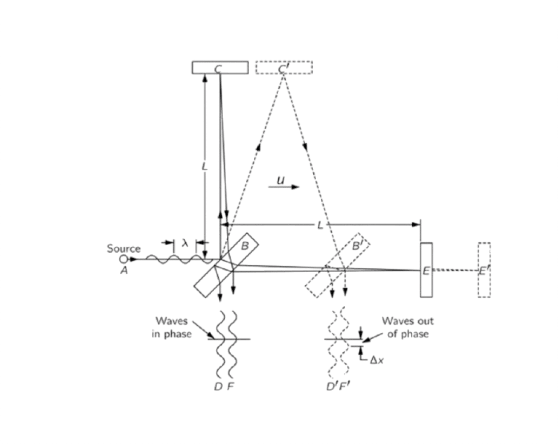
Let the supposed ether fluid move at a speed of u to the right. Therefore, light goes from B to E sped up and comes back from E to B slowed down by that factor of u. As for the light going from B to C and then C to B, there is no effect on the speed(vertical) except the light gets slightly deflected to the right(like how a swimmer trying to cross a flowing river gets deflected). Overall, since the light from the BE path takes longer to come back compared to the BC path, when the lights recombine on B, one would assume the two lights to produce an interference pattern because of the longer time period for BE. However, there is an interference pattern that forms experimentally. One may think ether flows to the left. Sure, flip the apparatus 180°still no effect. Maybe ether flows up? Again, no effect (even if the apparatus is flipped by 90°). Experimenters waited 6 months for Earth to be at the opposite side of its orbit to measure again, and still the same result. This can only mean one thing – there is no ether. Regardless of the orientation of the apparatus, the speed of light does not change because there is no interference, but rather the light gets reproduced with the same intensity as from A. But the earth moves through the Milky Way at some speed, and even after that fact, the speed of light did not change. This can only mean one thing – The Speed of Light is constant for every frame of reference. Regardless of your speed, the speed of light will always be c. Even if you move at a speed which is 99.99999% of c, light will still seem to be c. This is a very important and one of the first result of this theory.
What is the conclusion from the Michelon-Morley experiment and the car, Einstein, and you experiment? It’s that there is no absolute motion, only relative motion(except if you can move at the speed of light).
§ applications of the special theory of relativity
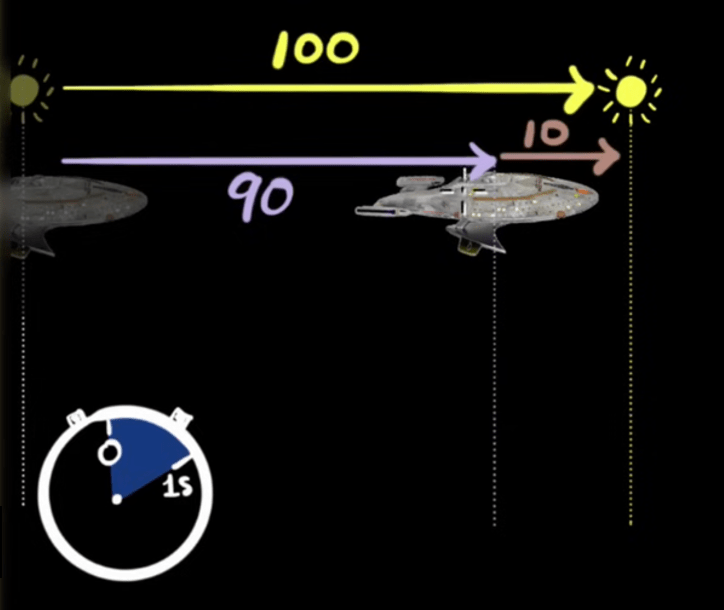
Let’s do a simple experiment here. Assume for a minute that the speed of light c is some 100 units/s and you have a spaceship moving at 90 units/s. So after 1s, the photon of light moves 100 units and the spaceship 90. So after 1s, won’t the spaceship see the photon 10 units away from it? Meaning, if you try and calculate from the spaceship the speed of light, it should be distance/time = 10/1 = 10 units/s. So, won’t this break the hypothesis that light has a constant speed for every frame of reference?
The thing is, the speed of light c is constant for every frame of reference. Even for the spaceship, it should be 100, not 10. So how do we get to 100? Uh, you essentially increase the value of the numerator by some bit and decrease the value of the denominator by some bit to get to 100. Literally, that’s the way we make distance/time as 100.
Decreasing the denominator means decreasing the time. But what does that even mean? Our entire thought experiment rests upon this external clock with us(the stationary observer), where both the spaceship and the photon move for 1s. What if, as 1s pass on our clock, some lesser time passes on inside the spaceship? Meaning, the clock inside the spaceship ticks more slowly than the one with us. So after 1s, it’s less than 1s inside the ship. So, on the converse, 1s inside the ship is like 3-4s on our clock. Tim has dilated. This is the phenomenon of time dilation.
But it’s not necessary for the time in the denominator to straight away become 0.1 to create 100. It can be more than that; it can be any value based on several parameters. The only other thing we can do is increase the value of the distance. But I can see that the distance between the ship and the photon is 10 units, so how does this work? Well, what if the size of the ruler to measure the distance between the spaceship and the photon for the spaceship people is smaller than the stationary observer? Meaning, their 10 units end before they reach the photon. So, for them, the photon is much further and maybe 30 or 40 units on their ruler, as compared to ours. Length has contracted. This is the phenomenon of length contraction.
These two combined phenomena act to get us 100 units/s. Therefore, both for the people on the spaceship and the stationary observer, light moves at exactly c.
There are three more ways to see this.
First, spaceships and ticker clocks. Picture this: there is a spaceship with a clock inside it. This clock has two parallel mirrors with a photon bouncing between them through reflection. Every time the photon hits the bottom mirror, we get a tick, meaning one cycle is completed(concept of a clock). Depending on the number of ticks, we can figure out the state of the ship. It looks like this –
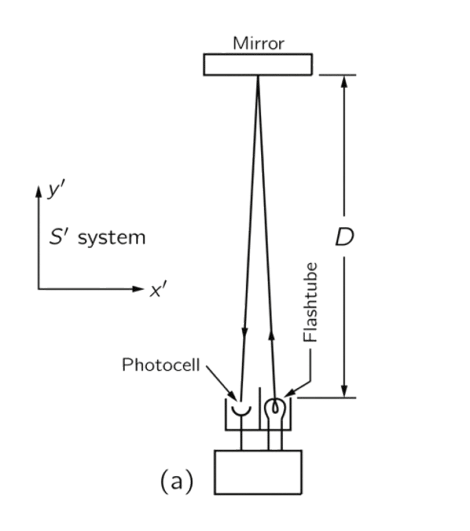
But now what if the ship moves? Say the ship moves to the right. The residents of the ship see no difference as they are in inertia with the ship, and so is the clock, so the up and down motion proceeds. However, for those outside the ship not moving with it, it sees a different story. The entire clock is now moving to the right as well, so the photon after it hits the bottom mirror goes to the top mirror in a diagonal direction because the top mirror moved to the right, and again diagonal to the right after reflection from the top mirror because the bottom mirror moved to the right. Or, like this –
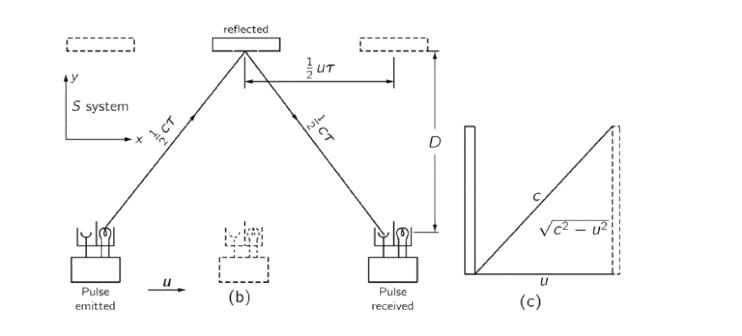
Here, diagonal distances are longer than straight ups and downs, thus the photon takes longer to conduct each tick for the outside stationary observers as it now moves longer distances. Longer ticks mean time inside the spaceship runs slower for stationary observers outside the ship.
But what if the clock is not this boring clock, but some high-end Rolex clock, or a radioactive clock, or some modern clock working on a different mechanism? Well, get two of them and perfectly synchronize them on Earth. Keep one on Earth and the other on the spaceship alongside the photon tick clock. If the modern clocks don’t go out of synchronisation, there will be a difference in the duration of the cycles of the modern clock and the tick clock, as the tick clock dilates. But if this were to happen, then the person inside the spaceship would find out that they are moving and can calculate their speed. This will break down special relativity completely since the foundational blocks are that no motion is absolute, but all relative, thus no one is truly moving(as in the Einstein-car experiment from earlier, where Einstein argued that he wasn’t moving). Thus, the tick clock and the modern clock need to have the same dilated cycles, out of sync with the clock on Earth.
There is another mind-boggling fact here. What if the clock is on a ship moving at the speed of light? Well, we can easily see that as the value of u increases(the speed of the ship), the resultant ticks of the photon gain more and more horizontal resultants. So the logical conclusion is that then at the speed of light, there is only a horizontal component parallel to the mirror for the photon, meaning the photon never ticks, and the clock freezes. This result is confirmed as proven below using the concept of the Lorentz factor, where time dilation becomes infinite. But the problem is that there is a paradox here – for us to make this conclusion, we must work upon a reference frame for light itself. This does not work because by definition reference frames are at rest(although one frame may be moving with respect to the other – like how for both Einstein and the guy at the end of the road experiment for both their individual systems they are at rest for their frames but moving when one is measured from the other), the speed of light must then be zero here(c = 0). This is not possible as special relativity will break down. So the only way infinite time dilation works is if we take a reference frame that does not exist, even though the dilation works. What’s the solution to this? I have no idea.
Remember the term length contraction? Well, we can use this tick clock to our advantage(as proved above, the mechanics of the clock do not matter, so we take the simplest one) to explain that intuitively. Here is how –
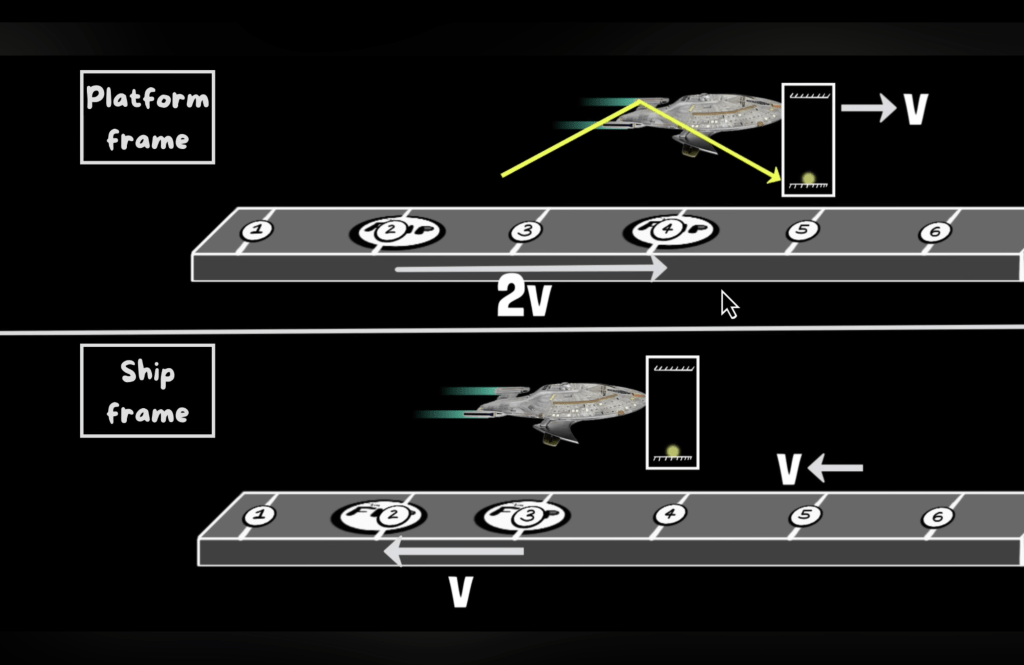
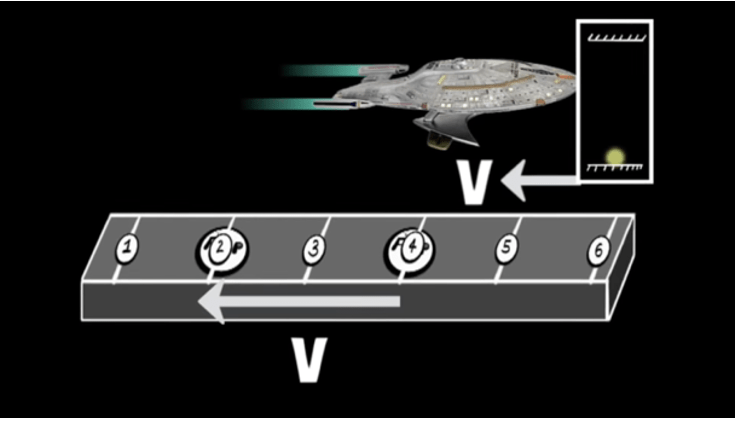
We take a ship and a platform and move the ship along the platform above it. The ship has a huge stamping machine that stamps the platform after every tick of the clock. When we take the ship’s frame of reference(lower image), for the people and the clock inside the ship, the ground is moving for them to the left at a speed v. It stamps the ground on the part of the platform marked 2, and then after 1 tick. Simply enough, it comes out to be 3(for example). What is the distance between points 2 and 3? Well, it’s simple – it took 1 second and v time to move, so a distance of v units.
But now take the reference frame of the platform, or the stationary observer outside the ship. The clock inside the ship is now dilated because of special relativity and ticks more slowly than the clock in the first case. So, its 1 tick is a bit after the 1 tick of the clock inside the ship, and thus the stamp is marked beyond 3 and point 4. Since each point is equidistant from other points, it’s the total distance is 2v units. Therefore, the length has contracted for the ship frame has contracted in comparison to the platform frame. But does this mean these two will disagree about the position of the second stamp? Nope.
See, when length is contracted, it’s not just length between 2 stamps, it’s every physical length you can measure – length between atoms, between molecules, people – anything. The entire world shrinks for them by this factor. So, for the person in the ship frame, the second stamp is at point 4; it’s just that to compensate for that, the entire platform below the spaceship is now contracted. It will look a bit like this(for the ship frame) –
You know what’s scary? This isn’t just about normal clocks. Even biological clocks get affected because of this. Every information from every neuron takes more time to reach its target as compared to the earth for those on the spaceship because of time dilation. The entire ageing process of those on the spaceship slows down for them as compared to those on Earth. Imagine if there are two twins – one is taken on the spaceship and the other is kept on Earth. After years of the spaceship constantly moving, the one on Earth will be older than the one in the spaceship, even though they are twins. This is because of time dilation. This is the Twin Paradox.
Second, this is actually just a fact further confirming to us the fact that time dilation is real. Muons in general have a half-life of 2.2 * 10-6s, meaning barely a fraction of a second. Now this is the half-life of muons made in a lab. But what about muons from other sources – natural sources like cosmic rays? These muons go from their source and are still detectable in gas chambers on our surfaces without disintegrating into other particles. This means only one thing that their half-life has increased. This is a direct result of relativity. The high speeds at which muons move in our atmosphere dilate the process of disintegration of the muons, increasing their lifetime.
Third is yet another spaceship. Suppose a man inside the spaceship places one clock at either end of the spaceship. How does he synchronize them? Well, the simplest method is to place a device at the dead centre of the ship. From here, we produce light signals that move in both directions towards each end and reach the clocks at the same time. For the man on the ship, both the clocks are synchronized, and life is good. But what about an observer not on the ship, stationary on earth, looking at the ship? To him, as the ship moves in one direction(say right), as the signals from the device are released, the clock to the left gets the signal first because the speed with which it gets the signal is the speed of the signal + the speed of the ship, while that on the right gets it at speed of the signal – the speed of the ship. Thus, the two clocks are not synchronised for the man on earth. So, which reference frame is of more importance? Well, neither because the man in the ship can argue that clocks at certain distances on earth are not synchronised because he is at rest according to him, while the earth is moving to the left(as the ship moves to the right for the earth observer). This reinforces the concept that there is no absolute motion, rather only relative motion, unless you reach the speed of light.
Therefore, events that are simultaneous in one frame(the ship) may not be simultaneous in another frame(the earth). This is called the Relativity of Simultaneity.
Our next job is to give a mathematical meaning to time dilation. We can do this using the Pythagorean theorem in the ticker clock experiment. The right-angled triangle in the last diagram is sufficient. There, instead of speeds, take distances, where distance = speed * time. For the diagonal resultant and the horizontal component, it will be the dilated time t, and for the vertical component(original without the ship going right), it will be to. After some algebra and rearrangements, we get the formula for dilated time t’ as –
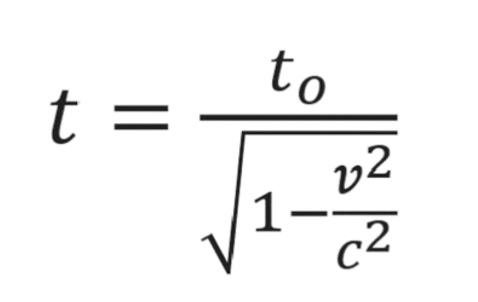
Here, the term below in the denominator is called the Lorentz Factor, which can be summarised as γ. So, we can write this equation as t = γto.
Therefore, γ = 1/√(1 – v2/c2)One interesting thing to note about γ is that it has no unit – it is simply a scaling number. The good thing about this fact is that it now allows us to scale every physical quantity of Newtonian mechanics with this. Every single one. This can be simply done by multiplying each quantity by this value. Some examples are –
Momentum, p’ = γp = γmv
Length contraction formula, L’ = L/γ
In the past, many examples and theories seen here, a phrase is always mentioned – motion is never absolute, but only relative unless moving at the speed of light. And motion being absolute at the speed of light is obvious because of the Einstein and red car experiment. Let’s now see what’s going on here.
Take a spaceship, for example(this is the last example of spaceships, I promise). This spaceship is moving at an incredibly high speed – its acceleration is say 1000 km/s2. This means, every second, its speed increases by 1000km/s. At first, not much effect can be seen. But as this value gets extremely large – that is, comparable(close) to the speed of light c, the v/c term in γ becomes very large, making γ itself larger and the dilated time larger. This results in the acceleration decreasing. How? Because at these large speeds and dilated time, the individual force carriers at the atomic level travel longer distances from subsequent atoms to feed the engines to increase the speed. As γ approaches 1(γ 1) or v approaches the value of c(v γ), γ approaches the value of infinity(γ 


No body with mass can ever move at the speed of light. Therefore, motion will always remain relative and NOT absolute in any frame of reference.
We can also infer another thing from this. If the spaceship does indeed approach the speed of light(v c), length contraction will occur to such high extents that at the speed of light, the contracted length will be L/
Another one of the crazy outcomes – possibly the most radical one from this theory is the existence of a 4th dimension. This dimension is not something we control or see like the 3 dimensions of our reality – only measure. You may not believe a word of what you just read, but let me show you how this might very well be true to sew together all the groundbreaking stuff we discussed above.
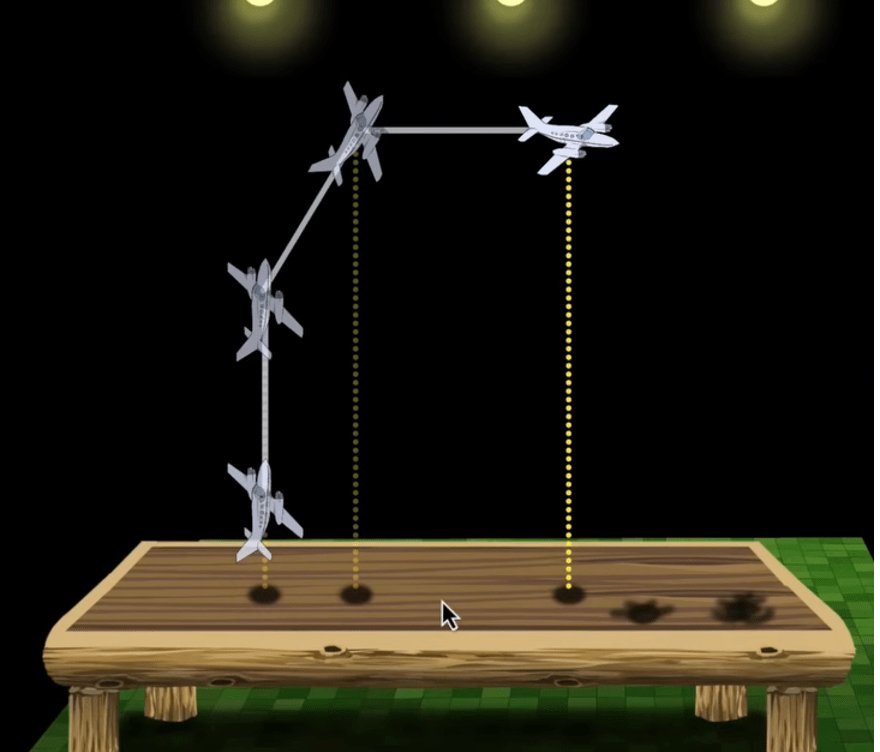
Take this thought experiment. Imagine an aeroplane that flies like this. Its speed is 1 m/s. It flies 1m straight up, then 1m to the diagonal, and then 1m horizontally. There are lights above the aeroplane and the table to cast a shadow of the aeroplane. Now, focus on the table. Imagine there are 2-dimensional beings on the table. These beings cannot comprehend the 3rd dimension of depth(or height), but can only comprehend their own dimension. The only way they can get some idea about the plane’s movement is by the shadows cast by the light through the plane on the table.
When the plane goes up straight, the 2D people think that the plane is just hovering in the air(not moved at all), even though it has for us(we are higher-dimensional beings). When it goes diagonally to the right, the 2D people think it goes a bit to the right(they can’t imagine it going diagonal because of the shadow). But when it goes straight to the right, it covers a great distance between the current and the next shadow because it doesn’t fly at an angle. You know what conclusion the 2D people will make? The shadow has accelerated. And this is a fair conclusion given that within the same time frames the shadows travelled different distances, going from 1st to 2nd and from 2nd to 3rd. But they will also notice another thing. The maximum speed of their entire universe is 1m/s. Things can go slower, at that speed, but never faster. And this will for them become a postulate.
This is much like how WE have postulated the speed of light c, to be a constant. The theory is that we are 3D beings seeing a shadow(or better a projection) of 4-dimensional space-time in our world, of how things operate there. In a way, we might be the table people seeing the plane move at c, and the 4th-dimensional beings might be the ones who can see the plane twisting and turning and whatnot.
But can the 2D people validate this entire concept? Let’s see how. Now, instead of there just being a floor and ceiling lighting, we also introduce a wall on the left and a light on the right to cast shadows(projections) of the plane on the wall. You may be wondering, “Oh, the 2D people can’t see the wall shadows, so what’s the point?”. Well, yes, you are correct. But, we can’t see time, can we? There is no way we can see its flow through space, but we can measure it using our clocks. So what if these 2D people can’t see the wall projections but can measure them(the method doesn’t matter), much like how we can’t see time but can measure it? Here is a pictorial representation –
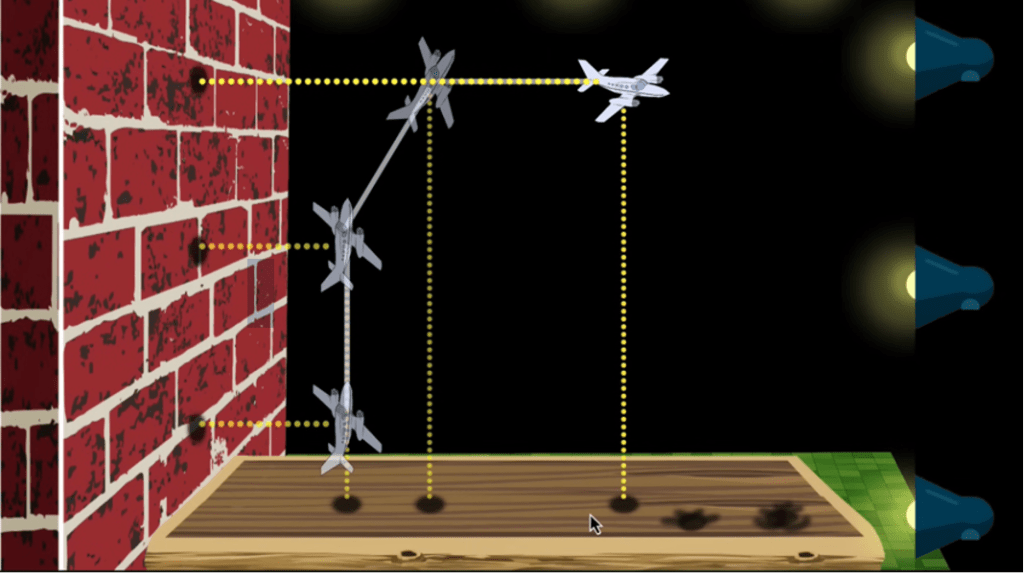
Did you see it? When the plane goes up, the 2D people conclude that the plane didn’t move in space(their 2D space) but moved along the wall. When the plane went diagonally, it moved both in space and along the wall. And when it went straight to the right, the plane moved only through space. So in the first case, the plane moved(along the wall), without moving(in space). This is the idea of a space-time curve. The wall projections represent time, and the floor projections represent space. The idea is that the 2D people can see the plane move in space, but only measure it moving in time, like in these cases.
In the first case, the plane moves in time but not in space. In the third case, the plane moves in space but not in time. This again backs up our concept of relativity because at the speed of 1m/s, which is the maximum for the 2D world, time has frozen.
Just extend this concept to us. We are the 3D people who can see the plane’s space shadow and only measure its time shadow, but the 4D people can see the plane itself. If the plane moves at c, time has frozen(for those observing, not those in the plane, if they can survive on infinite mass that is).
§ energy-mass equivalence
This is the concept sitting at the heart of Special Relativity. Even those without a scientific background are aware of this idea and have heard the famous equation, which is based on this, one that forever changed the course of history and of modern science. Our understanding of this will involve a combination of everything we have discussed so far.
Let’s start with an experiment. Say there is an atom with 10 units of energy. This atom, if left for some time, releases 2 photons in opposite directions, with each photon carrying 1 unit of energy. So, obviously, the atom lost 2 units of energy and now has only 8 units of energy left. Why lose 2 photons and not 1? Well, the idea is that if you lose 1 photon, the atom will recoil. So to avoid this recoil and make sure the atom stays at the same place, at rest, we make the atom lose 2 units of energy in the opposite direction as photons. Now the observer who records the energy of the atom to be 8 units is Einstein(for example). Einstein has he sees this experiment and notices his friend, Anant, moving in a spaceship. So, as any normal person would do, he hops on the spaceship moving to the right of the atom at a speed v. Thus, for Einstein, the atom now moves to the left with a speed v(as for him, he is at rest). Thus, the atom now has a kinetic energy equivalent to ½(mv2), where m is the mass of the atom. It will look a bit like this –
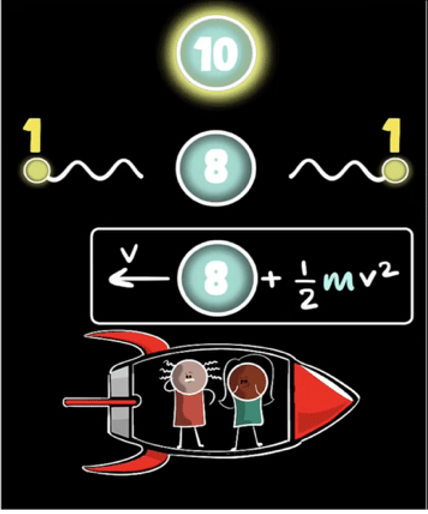
But what about Anant? See, the thing is that Anant has been in the spaceship since the very beginning, so the atom was always moving for him, unlike Einstein, who was at rest and then started moving with a speed v to the right with Anant in the spaceship. Naturally, the energy from Anant’s frame of reference needs to be the same as from Einstein’s frame of reference. But will the atom now lose 2 photons with 1 unit of energy each and thus be left with 8 units of energy? NO.
One thing you might forget is that light is also a wave(kind of ironic considering we are talking about the theory of the founder of the concept of a photon), and waves, when produced from moving sources(the atom to the left), when their frequency is measured, come shifted from the frequency if the source was not moving. This is the Doppler Effect. Let’s see how –
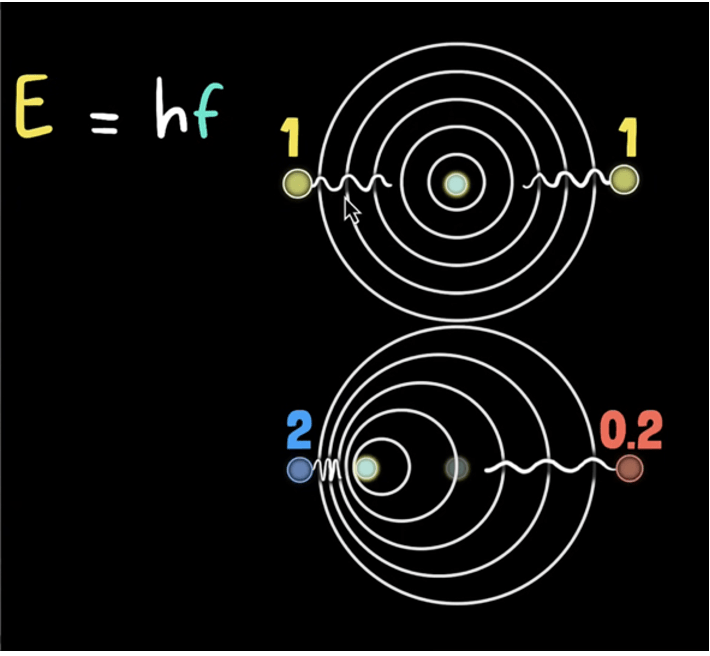
In the top picture, we see a still atom. When it produces the light, the wavefronts are uniform, and two 1-unit energy photons are produced.
In the bottom picture, the atom is now moving to the left (like for Anant). So, you can clearly see what happens. Since the atom moves to the left, the waves it produces to the left get compressed with one another by the next wave the atom produces in a new position, now a bit to the left of the previous position. Since the distance between concurrent waves reduces, so does the wavelength. Lower wavelength means higher frequency. Thus, the photon produced to the left has higher energy than 1 unit(2 units as shown here) – the photon to the left has blue shifted(increased in frequency). For the light waves on the right, it’s the vice-versa. The atom moves away every second, so the next wave and the current wave have more distance than the previous two. Thus, the wavelength increases and frequency decreases, lowering the energy by less than 1 unit(0.2 units shown here) – the photon has redshifted(decreased in frequency). And the energy change is clear because E = hf.
So for Anant, the atom has lost 2.2 units of energy from photons in total, unlike Einstein, for whom only 2 units of energy were lost(remember, Anant was always in the ship – Einstein only hopped on after the photons were lost). Of course, for Anant, the kinetic energy ½(mv2) is there, but the weird this is this. The energy for both frames of reference should be the same. Meaning, this should be true –
Energy for Einstein = Energy for Anant
½mv2 + 2 = ½mv2 + 2.2
½mv2 = ½mv2 + 0.2
Now obviously this does not make any sense – this equation can’t hold. But we know for a fact that no frame of reference holds priority, so both of them should read the same energy, and yet, this happens. How do we fix this? Remember how we just increased the numerator and decreased the denominator in an experiment to make sure the speed of light is always c? We can do something similar. Just modify this equation in a way so that it holds.
Here, RHS > LHS. The ONLY way we can get to equivalence(RHS = LHS) is if we increase the value of the LHS or decrease the value of the RHS. The speed is constant, and we can’t tamper with the constant 0.2, so the only thing left is mass. So equivalence can be reached IF, mass on the LHS is greater than the mass on the RHS. But these are masses of the same atom – how can they be different in the same equation? But look closely. The mass on the LHS is the mass of the atom before it shot the photons, while the mass on the RHS is the mass of the atom after it shot the photons(because the kinetic energy of the atom always existed for Anant, but for Einstein, it existed only after the 2 photons were shot and he sat on the ship with Anant).
So, this equation is telling us that by losing the photons, the atom loses mass. This means the atom lost mass on releasing energy – mass is equivalent to energy. That lost mass was converted to the energy it released.
We can now rearrange the equation and write it like this –
½(Δmv2) = 0.2
Now this 0.2 is 2.2 – 2. The 2.2 is the energy the atom lost from the moving frame, and the 2 is the energy the atom lost from the rest frame. So, we can also write the equation as
Emov – Erest = ½(Δmv2)
Now, if you conduct some boring algebra on the Doppler effect from the idea of relativity, including the Lorentz factor, you will eventually get –
Emov = γErest
Now plug this back into the equation above, and we get –
γErest – Erest = ½(Δmv2)
Erest(γ – 1) = ½(Δmv2)
Erest[(1 – (v2/c2))-1/2 – 1] = ½(Δmv2)
After some Binomial expansions and rearrangements, we get. –
E = Δmc2
His is hands down one of the most, if not the most important, equations in all of human history. One that forever changed the world of physics – The Einstein Mass-energy equivalence relation. Words can never express just how consequential this relation was.
One thing to note here is that Δm means the change in mass. It means the mass of the object in question on lost, which was converted to energy.
And with this, we come to the end of the Special theory of relativity. What lies ahead are the results of the special theory of relativity, which go further down the lane of understanding how photons work, and how these results eventually pile up to form our best understanding of the nature of atomic and subatomic particles.
§ photons have no mass
Photons have no mass, or light has no mass. This may seem weird at first, considering photons are particles, but it’s actually true. One may say, “Oh, light is also a wave and waves don’t have mass, so photons can’t have mass”. Well, that explanation then contradicts the particle nature of light, and if photons don’t exist, then we are wasting our time, because they do. Let’s see here why that is the case.
We discussed E = Δmc2 above. One may just say that we can rearrange the terms and say m = E/c2, and photons do have energy E = hf, so in some way m = hf/c2. Nice attempt, only thing is that this is wrong. We will now further discuss why photons have no mass and yet have properties that classically only lie with things having mass.
Let me start off by asking you a question – what is mass? Seems quite silly because this is not only something that is taught to every school-going kid, but also because it’s intuitive. We can feel mass. When you pick up heavy weights in the gym, you can feel their weight. The most basic definition in the most layman’s language is that mass is the ‘amount of stuff’ inside some object.
Take the human body, for example. What ‘stuff’ is the human body made of? Its organs, bones, tissues, vessels, blood, etc. So our mass is the combined mass of these individual constituents. Okay, but what’s the mass of these organs, bones, and whatnot? It’s the mass of the molecules that makes them, which are made of atoms, which are made of electrons, protons, and neutrons. Further, these protons and neutrons are made of quarks. Okay, so now we are fully clear that our body, or moreover, every object is made of quarks and electrons. The combined mass of thesequarks and electrons is the mass of our objects. But what is mass? We still have not answered the question.
See, as it turns out, quarks and electrons interact with something called the Higg’s field. The quantity of that interaction gives them something called mass. It’s an intrinsic property.
Okay, now we have the mass of the quarks and electrons, and when we combine the mass of the billions and billions of electrons and quarks, we should get the mass of the entire body. Let’s do that! And the answer is… about less than 2% of our actual mass. Wait what. That does not make any sense. Where does the rest of the 98-99% of our mass come from? See, we can answer this question by looking at a proton.
A proton is made of 4 quarks. If you add the mass of these 4 quarks, it’s about 1% of the actually calculated mass of a proton. The idea is that these quarks are held together by things called gluons. They act as a vessel to carry the Strong nuclear force, one of the four fundamental forces of nature. It is the strongest force in nature. These forces result in a lot of energy inside the proton. This energy is what holds the 4 quarks together. But we also learned that energy and mass are equivalent by a simple formula. So we can say that the energy holding together the 4 quarks is E, then the mass is m = E/c2. And this is the answer! This mass is what gives the proton its 98-99% mass. If we zoom out, we can say that 98-99% of the mass that is unaccounted for is the mass from the energy that holds together these atoms, whether it’s the 4 quarks inside protons and neutrons or electrons. Most of the mass of a body comes from m = E/c2. So at the fundamental level, we are actually measuring energy – no such thing as much(only Energy/2).
Now, one can argue a very interesting thing – what if I take a spring and compress it? Compressing it compacts the atoms together, increasing resistive forces between atomic and subatomic particles, and increasing energy(potential energy). Since energy is more, can we say that the mass has increased? Yes! This totally works and the mas has increased. Great!
So this also means that if I heat my cup of coffee, its mass also increases because the energy of individual atoms increases, increasing mass. In fact, if you measure the weight of the cup of coffee, you will see a very small difference, but indeed a difference in the mass as it increases.
So this also means that if I take a stationary baseball and a moving baseball, the moving one has more mass, because it now has kinetic energy. And the answer is…no. No, the mass will not increase.
How does this make sense? On one hand, we are increasing the energy and getting more mass, and on the other, we are not. See, the thing is that when we increased the energy of the coffee and the spring, we increased the potential energy. It means we increased the energy of individual atoms and distorted the molecular structure(some atoms now have more energy than neighbouring ones). But when we throw the ball, do we change the molecular structure(of course, wind resistance compresses the ball, but we can ignore that for now)? Nope. If you take the reference frame of any atom, its neighbouring atoms are just the same because all of them are moving at the same speed.
Another way to look at it is asking the question “how do we measure the mass of this moving baseball?”. The simplest way is to take a weighing machine and run alongside the ball at its speed so that relative motion is zero, the ball is at rest for you, and then the mass is measured. But that is the same case with the ball that never moved and was stationary because even in that case, the relative motion is zero. So the mass never increases.
But this does not mean the energy of the ball has not increased. See, until now we thought that the total energy of any object or any system is E = mc2. Evidently, that is not true. The total energy of a system, ET, is the sum of the system’s energy at rest and the energy of motion, given by –
ET = Erest + Emotion
It is this energy of rest that is mc2. So even if the ball starts moving and gains an energy of motion(½mv2), the mass is still the same. So whenever we need to find mass, we need the energy in the rest frame.
Now, instead of taking balls, let’s take photons. We can measure the mass of the ball by being at rest with it(either the ball itself doesn’t move with respect to you, or you move at its speed to make relative motion). Either way, we need a resting frame of reference to measure the mass. Now we don’t know any mechanism to stop photons, so the only thing we can do is take a weighting machine, sit on a rocket ship, and move at the speed of light- wait, you can’t do that. Special relativity blocks any object from moving at the speed of light, c(because you need infinite energy). Okay, well, how about we go at 99.99999% the speed of light so that the photon is just a little faster than us, and then measure it. Again, this won’t work! This is because Einstein’s postulates say that the speed of light is the same, c, for every reference frame.
This means, photons will always be in motion. No reference frame around the entire universe will ever be able to see photons at rest. So if we say that an object is at rest with respect to us, so its energy of motion is zero(Emotion = 0), we can argue that since photons are never at rest with certainty, their energy of rest is zero(Erest = 0). Thus, if we try to find its mass, m = E/c2, it will be zero!
Photons have no rest mass is the correct terminology, but that’s all that matters. This means the only energy photons ever have is the energy of motion. That energy of motion is the hf we discussed earlier(Emotion = hf). This energy of motion is now the total energy of the photon.
Therefore,
Photons have no mass, but have energy.
Photons also have another thing we assume to be with something having rest mass – momentum. This definitely does not make any sense because by definition, we define momentum as –
p = mass * velocity = mv
It’s right there in the definition. If photons have no mass, then their momentum should always be zero. Before we proceed, let me ask you a question – what is momentum?
Literally speaking, it’s an object’s ability to apply a force or to push something. Some say it’s the quantity of motion, but the first definition is a better one. This means the more momentum, the more ability that thing has to push something. We can confirm this because Newton defines Force as the rate of change of momentum (F = dp/dt).
So theoretically, if photons have no mass, they should have no momentum and thus no ability to make something move.
Now I want you to see this. This is a comet that orbits the sun. The first picture to the left shows you what you would expect. That is, the tail of the comet moves along the orbital path of the comet around the sun and follows the comet’s overall trajectory. But the second picture is what actually happens. The tail is always somewhat pushed away from the sun. We cannot give gravity the credit because that is, first of all, not a force(as explained in general relativity, not important to our discussion), and second of all, gravity gets the comet to be in that orbit, not alter the direction of motion of the comet’s tail. The reason is because of the light coming from the sun. This light pushes away the comet’s tail constantly and gives the second picture – a representation of what actually happens. This is the only logical explanation. So this example proves to us that light does have the ability to push things away, so it can have momentum.

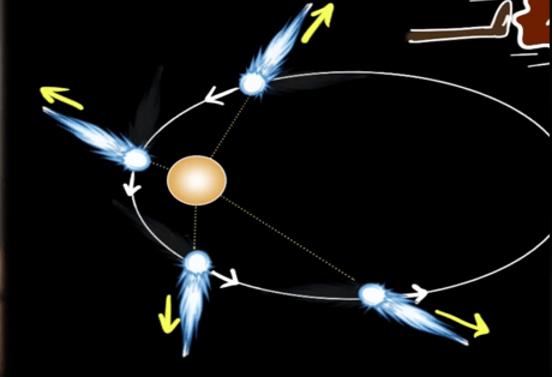
Light has momentum – only the classical definition can’t explain it because that is an approximation for things travelling at low speeds. There are two explanations – the first is the common and boring one –
The actual Einstein energy equation is –
E2 = (mc2)2 + (pc)2
Since light has zero rest mass, m = 0. Therefore,
E2 = 0 + (pc)2
So E = pc
p = E/c
Tada!!
Are you satisfied with this reasoning? Absolutely not. Let me now show you a better and more intuitive explanation of this phenomenon. This will require the wave nature of light and basic high school physics.
Light is an electromagnetic wave. An electromagnetic wave is when you have perpendicular electric and magnetic fields going out in space. These fields are also perpendicular to the direction of motion. They look something like this –
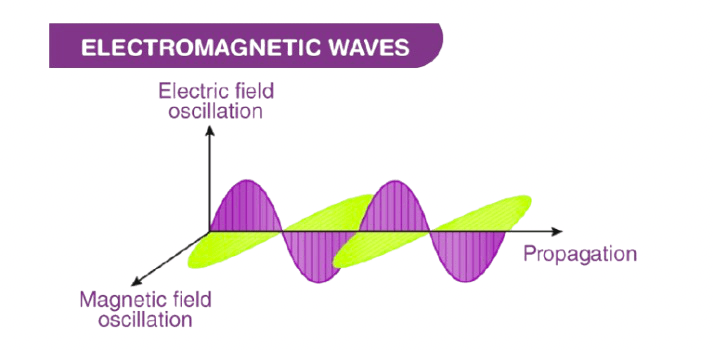
The purple part(along the vertical axis) is the electric field, and the green part(along the horizontal axis) is the magnetic field. Now let’s take an example.
If light does have momentum, then at the atomic level, low levels of light should have the ability to move subatomic particles like electrons. So let’s put an electron in the path of the EM wave. It should look something like this –
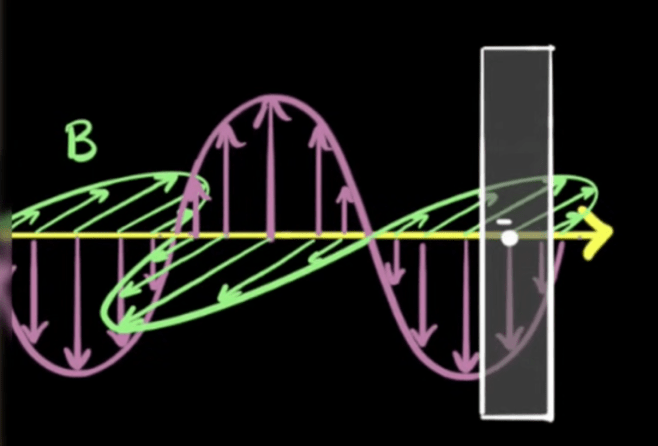
We now take both parts of the wave individually for analysis
First, there is the electric field(the purple part). When the electric fields through hit the electrons, a force emerges. The reason is that the electrical(or coulombic) force is given by the formula –
FE = qE
So in this case, the q is the charge on the electron(e) multiplied by the intensity of the electric field. This force will be in the upward direction because electrons have a negative charge on them. Great, so now the electron will move up! But now, when the crest of the wave hits it, the force will be in the downward direction because the electric field is in the upward direction. So the electron that went up will now go down. Over time, as the electron is exposed to the electric field, it will just oscillate up and down and not actually move anywhere. This is what it looks like –
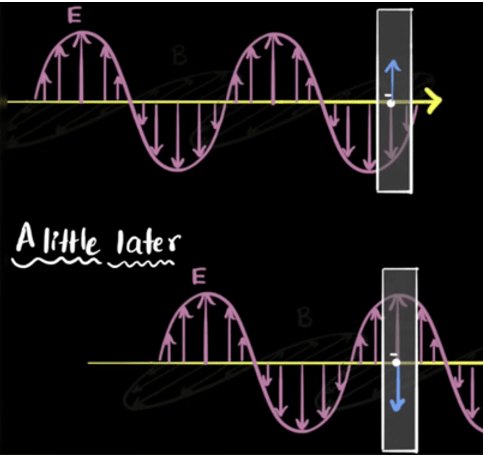
The verdict is that any movement due to the electric field component is not going to occur.
Second, there is the magnetic field(the green part). Unlike electric fields, magnetic fields have forces that result from them perpendicular to the direction of motion. Their direction can be found by using the formula –
FB = q(v x B)
‘x’ here represents a cross-product, which essentially says that the resultant of the two things getting multiplied will be in the direction perpendicular to both the things getting multiplied(here, v and B). ‘v’ is the speed of the electron, and ‘B’ is the magnitude of the magnetic field. So let’s start our assessment. When the trough of the electric field hit the electron, the trough of the magnetic field hit it. As shown in the picture above, the direction of motion of the electron is upward. Now, if we use the right-hand rule(which says that during cross products, your fingers point in the direction of the first vector, then you curl in the direction of the second one and get the direction of the resultant). If we point our right hand’s fingers upward and curl them in towards the screen, our thumb will point to the left. When the trough of the electric field and the crest of the magnetic field hit, our fingers point down, we curl out of the screen, and again, our thumb points left. So in both cases, the force is to the left. But since this is an electron with a negative charge, it will move to the right(because now the magnetic force is always to the right)! This is what it will look like –
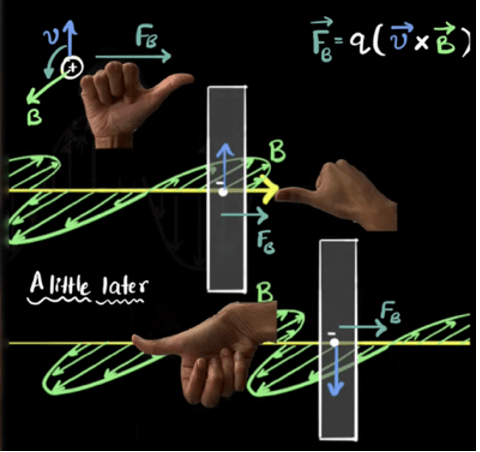
We have not proven just by using high school Physics that light does have momentum owing to its wave nature, even though it is massless. We will not use this very notion to derive the formula for light’s momentum(although I promised to refrain from boring algebra, showing this is necessary to prove how simply it is to imagine such a concept that feels extremely difficult at first) –
FB = qvB
Now, E*B = c, qE = FE, therefore –
FB = qv(E/c)
FB = (qE)v/c
FB = FE(v/c)
Now, Power = Energy/Time = Work/Time = (Force * distance)/time = Force*(distance/time) = Force * speed = F*v
Therefore, we can say that F*v = Energy/time. Replacement gives us –
FB = (Energy/time)/c = Energy/(time*c)
Also, Newton’s second law defines Force as the rate of change of momentum, or
F = momentum/time = p/time = Energy/(time*c)
Simplify terms and rearrange, you get –
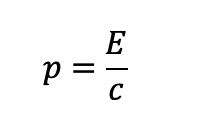
And thus, we have derived by basic physics and intuition that light has momentum, even though it does not have any mass.
§ references
document references
- https://astro1.panet.utoledo.edu/~ljc/PE_eng.pdf
- https://users.physics.ox.ac.uk/~rtaylor/teaching/specrel.pdf
book references
- The Feynman Lectures on Physics: Mainly Mechanics, Radiation, and Heat – Richard Feynman, Robert B. Leighton, and Matthew Sands
- The Feynman Lectures on Physics: Quantum Mechanics – Richard Feynman, Robert B. Leighton, and Matthew Sands
- Physics for Scientists and Engineers with Modern Physics – Raymond A. Serway and John W. Jewett, Jr
- Principles of Physics: 10th edition – David Halliday, Robert Resnick, Jearl Walker
youtuber references
- Credits to Floathead Physics – https://www.youtube.com/@Mahesh_Shenoy
- Credits to Veritasium – https://www.youtube.com/@veritasium

 Kosmonomy
Leave a reply to Pushpa Tripathi Cancel reply